

Leadframe Package
Fully customizable OEM solutions for high-volume production. As a leading semiconductor packaging manufacturer, we provide robust QFN packaging for automotive and industrial sectors requiring…
View productWanYing Chip Packaging & Testing builds customized BGA/LGA/PGA interconnect packaging on a standardized bga substrate, pairing precision electrical and mechanical connections with production-grade semiconductor packaging materials so a new design can move from prototype sampling to mass production on an assembly line you already run.
Choose by requirement
All three interconnect families come from the same packaging line, so the decision is not about availability — it is about how your part attaches, how heat leaves it and whether it ever has to come off the board.
| Interconnect | How it attaches | I/O density | Thermal behaviour | Rework profile | Typical end use |
|---|---|---|---|---|---|
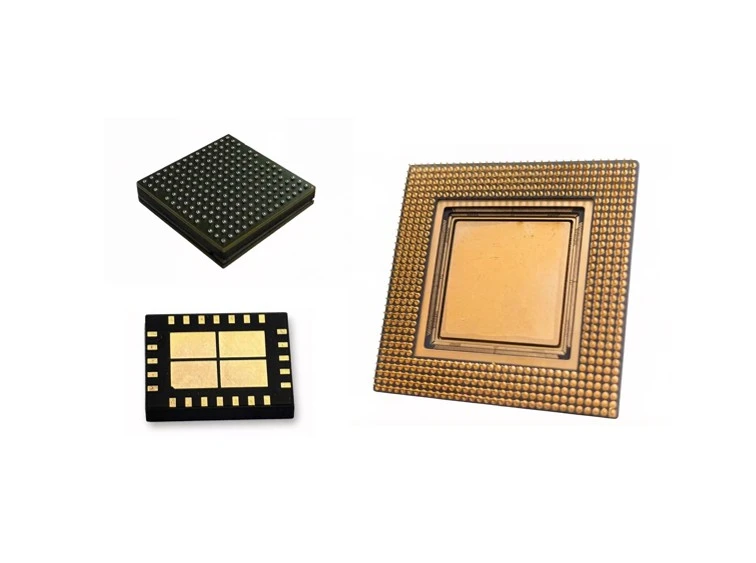
| BGA | Solder ball array on the bottom side of the substrate | Extremely high — thousands of pins | Short signal paths with low parasitic inductance | Balls self-align during assembly, reducing placement errors and improving yield | CPUs, GPUs and FPGAs |
| LGA | Metal land pads on the bottom side, without solder balls | High, carried across a planar pad field | Uniform contact pressure across the plane; better heat dispersion and reduced thermal resistance | No ball or pin deformation risk — contact is made through the socket | High-end processors and server chips |
| PGA | Ceramic or plastic substrate with pluggable pins | High, carried by pluggable pins | Robust mechanical connection with a repeatable plug-in interface | Easy insertion and removal for convenient rework and streamlined maintenance | Legacy workstation CPUs and ruggedized military/aerospace chips |

Interconnect 01
Choose BGA when pin count and signal integrity are the binding constraints and your line can run a reflow process. Confirm that your assembly partner can place and reflow a balled package before you freeze the layout — the self-alignment behaviour helps, but the process step still has to exist.
Interconnect 02
Choose LGA when the part sits in a socket and the thermal path has to be repeatable after every re-seat. Ask your board and socket supplier to confirm the pressure hardware, then align the pad field with the socket footprint — the flat contact plane is what delivers both the electrical uniformity and the heat flow.
Interconnect 03
Choose PGA when the unit must survive field service, repeated insertion cycles or a mechanically demanding environment. Plan the socket and retention hardware with the same care you give the package, and confirm the pin arrangement against your socket before committing to tooling.
What decides it
Read down the left column, find the requirement that governs your project, and follow it across to the interconnect family that matches.
| Your requirement | Recommended interconnect | Why this family fits |
|---|---|---|
| Highest available pin count with the shortest signal path | BGA | BGA delivers extremely high I/O density — thousands of pins — with short signal paths and low parasitic inductance. |
| Socketed interface with a repeatable thermal path | LGA | Land pads create uniform contact pressure across the plane and reduce thermal resistance, which suits high-end processors and server chips. |
| Field repair, servicing or repeated insertion and removal | PGA | Pluggable pins allow easy insertion and removal for convenient rework, without a soldered joint to reflow. |
| High-vibration or mechanically demanding environment | PGA | PGA provides robust mechanical connection strength, which is why ruggedized military and aerospace chips rely on it. |
| Assembly line that must keep its existing reflow process | BGA | Solder balls self-align during assembly, reducing placement errors and improving yield on an established flow. |
| Prototype that has to scale to mass production on the same line | BGA, LGA or PGA | The standardized BGA substrate and its LGA and PGA variants are designed to integrate with existing assembly lines. |
Recommendations follow the published descriptions of the BGA/LGA/PGA package range. Confirm the final choice against your own design rules, socket hardware and assembly-line capability before tooling.
Customization and line integration
The range is built as a modular, customizable design: ball pitch and pin arrangements are variable, and the packages suit various substrate sizes. The standardized BGA substrate, together with the LGA and PGA variants, is intended for seamless integration with existing assembly lines and supports workflow efficiency from prototype stages through to mass production.
Treat the RFQ as a line-fit question, not just a part question. When you send pitch, pin layout, substrate size and volume together, the package format can be matched to the assembly line you already run instead of forcing a process change later.
Send your substrate size, ball pitch or pin arrangement, I/O target and volume plan, and the package format can be customized around the assembly line you already run — from prototype samples through to mass production.
Request this package, submit your RFQ, or talk to the packaging team about socket hardware, thermal path and rework requirements.
Keep adjacent product options together for a faster catalog comparison.
Fully customizable OEM solutions for high-volume production. As a leading semiconductor packaging manufacturer, we provide robust QFN packaging for automotive and industrial sectors requiring…
View product

start with four questions: how many i/os the design needs, whether the part is soldered or socketed, how heat leaves the package, and whether the unit must ever be removed. bga carries extremely high i/o density through solder balls; lga uses metal land pads for uniform contact pressure and better heat dispersion; pga uses pluggable pins where rework and mechanical robustness matter most.
the package range is described qualitatively rather than with fixed numbers: ball pitch and pin arrangements are variable, and the design suits various substrate sizes. send your target substrate dimensions, pitch or pin layout and i/o count with your rfq so the package can be matched to your board.
bga packages place a solder ball array on the underside of the substrate, which is why they suit cpus, gpus and fpgas — designs that need thousands of connections with short signal paths and low parasitic inductance. the inherent self-aligning behaviour of the balls during assembly also helps manufacturing yield.
lga uses metal land pads on the bottom side without solder balls, which removes ball or pin deformation from the picture. contact pressure is uniform across the plane, thermal resistance is lower and heat disperses better — a combination used in high-end processors and server chips.
pga builds on a ceramic or plastic substrate with pluggable pins, so parts can be inserted and removed easily for convenient rework. that makes it a fit for legacy workstation cpus and ruggedized military or aerospace chips, where mechanical robustness and streamlined maintenance matter.
the standardized bga substrate, together with the lga and pga variants, is designed for seamless integration with existing assembly lines, and the customizable design supports both prototype stages and mass production. share your line's process constraints in the rfq so the package format can be confirmed against your flow.